1/4
每日一花
孙不浪
Nelumbo nucifera — the lotus that outlives empires
The Sacred Lotus can keep its seeds viable for 1,300 years, heats its own flowers, and gave engineers the blueprint for self-cleaning surfaces. A complete botanical profile of Nelumbo nucifera.
2026/05/20 13:49:18
图集
Its seeds can lie dormant in lake-bed sediment for over a thousand years, then sprout. The lotus isn't just a symbol — it's a genuine botanical outlier.
What it is
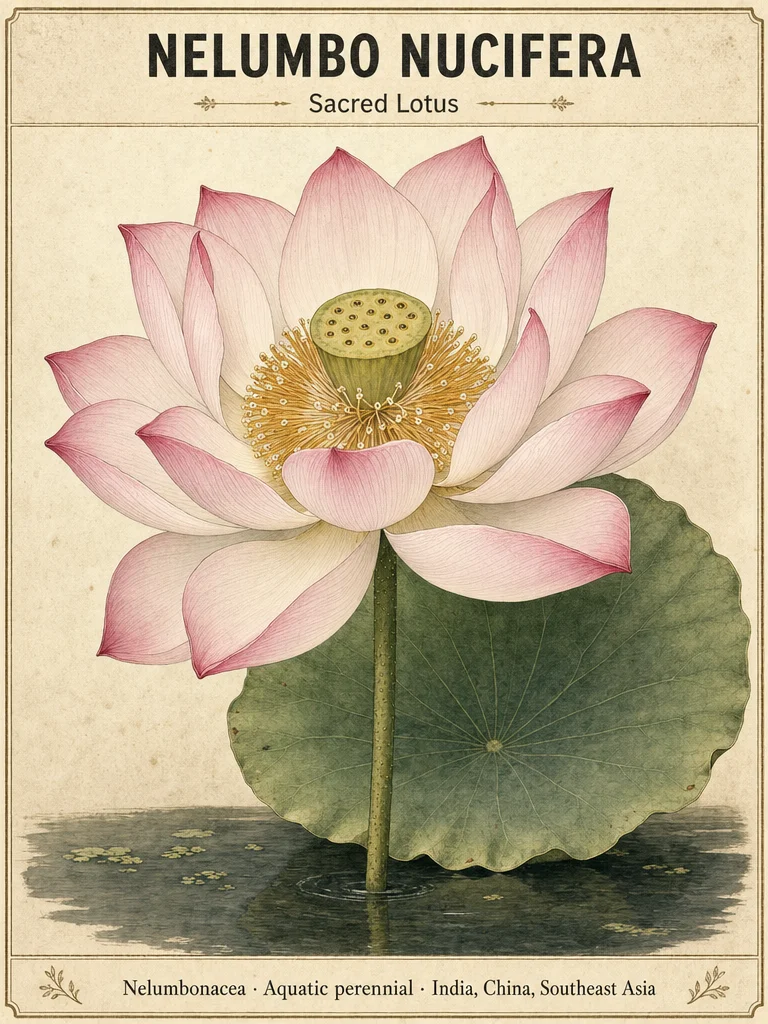
Nelumbo nucifera, the Sacred Lotus, is an aquatic perennial in the family Nelumbonaceae — a lineage so ancient it shares no close living relatives. Unlike waterlilies (Nymphaeaceae), which it superficially resembles, the lotus holds its flowers and large circular leaves entirely above the water surface, sometimes reaching 150 cm tall.
Two naturally occurring species exist in the entire genus Nelumbo: this one across Asia and northern Australia, and Nelumbo lutea (American Lotus) in North America. That's it. The whole genus.
Where it grows
Native range runs from the Caspian Sea coast east through the Indian subcontinent, Southeast Asia, southern China, Japan, and into northern Australia. It colonises shallow, still or slow-moving freshwater — ponds, paddy field margins, river backwaters — where water depth stays between 0.5 and 2.5 metres and sediment is rich.
Today cultivated varieties are grown on six continents. In China, rhizome cultivation covers millions of hectares; the lotus is both an ornamental and a major food crop.
The flower
Flowers open before dawn and close by early afternoon — the cycle repeats for three days, then petals drop. During this window, the flower maintains its own temperature, staying 10–15°C warmer than ambient air through a process called thermogenesis (the same metabolic trick that let early-diverging angiosperms attract insect pollinators before warm-blooded animals existed). When you hold your hand near an open lotus flower, you can feel the heat. 1
Petal count varies from 20 to over 100 depending on variety. Colour ranges from pure white through pale pink to deep rose; yellow varieties come from N. lutea hybrids.
The seed pod and its longevity record
After petals fall, the conical, porous seed receptacle dries and hardens. Seeds are tucked into individual chambers. The famous longevity record: radiocarbon dating confirmed that lotus seeds excavated from a dry lakebed in Liaoning, China, germinated and flowered after approximately 1,300 years of dormancy — the longest confirmed viable seed dormancy of any plant species. 2
The seed coat's impermeability is the mechanism: a wax-protein layer so effective it resists water uptake entirely until physically scarified.
The leaf surface
Lotus leaves are the original superhydrophobic surface. A microstructure of waxy nanoscale bumps causes water droplets to bead up and roll off, carrying dust and debris with them. This lotus effect has been studied since the 1970s and now directly informs the design of self-cleaning coatings, textiles, and architectural materials. 3
Uses
Every part of the plant is used somewhere:
- Rhizome: sliced and stir-fried or braised; a staple vegetable in China, Japan, and Korea
- Seeds: eaten fresh, dried, or ground into lotus seed paste (filling for mooncakes)
- Leaves: used as natural food wrapping, conferring a faint green fragrance to sticky rice dishes
- Stamens: dried for tea; said in traditional practice to calm the mind
- Petals: garnish, occasionally dried for decorative use
In brief
| Family | Nelumbonaceae |
| Genus / species | Nelumbo nucifera |
| Common names | Sacred Lotus, Indian Lotus, Bean of India |
| Bloom season | June – September |
| Flower lifespan | 3 days |
| Flower temperature | Up to 10–15°C above air temperature |
| Seed longevity | Confirmed 1,300 years |
| Native range | Caspian Sea east to Japan and northern Australia |
| Habitat | Shallow freshwater, 0.5–2.5 m depth |
Sources: Seymour & Schultze-Motel (1996) Nature; Shen-Miller et al. (2002) American Journal of Botany; Barthlott & Neinhuis (1997) Planta.
评论